Part I. The AI Worker Paradigm
- Status
- stable
- Owner
- Panaversity
- Approved
- Panaversity ·
Note
You are here: Part I. The AI Worker Paradigm
| Journey | Where you are |
|---|---|
| Capability | You can use an AI assistant. This part teaches you to see an AI Worker as a role you manage, and to describe one. |
| Certification | No credential yet. This part builds foundations for PCAO-F, the Panaversity exam you take after Part II. |
| Economic | You can describe one role in your field that an AI Worker could own. That is the first step on every economic route. |
- Portfolio artifact: a one-page Role Contract draft, for a role in your own field or for Brightline's AP Worker. It counts toward milestone B, which Part III completes.
- Who reads it: every route reads all four chapters in full.
- Before you start: the pages before Part I, especially How to Use This Book.
- What comes next: Part II teaches you to manage an AI Worker, which means you brief it, review its work, and set its authority.
What this part is about
Many people still use AI the way they learned in 2023. They ask a question, copy the answer, and finish the job by hand. The products have changed since then. Behind the same text box,1 an AI system can now take a task, work on it for hours, and hand back a finished result.2 Some products can hold a role and do the same work every week.3
That changes the skill you need. You no longer only write good questions. You hand over work, set limits on it, and check what comes back. In other words, you manage.
Part I gives you the ideas you need before you manage anything. It explains what changed behind the text box and what an AI Worker actually is. It also explains the rhythm that every piece of delegated work follows, and the architecture that keeps a worker trustworthy. It is written for everyone. You need no technical background, and you write no code.
What you will be able to do
By the end of Part I you can:
- explain what changed behind the AI text box between 2023 and 2026
- tell the difference between an agent and an AI Worker, and between an AI Worker and an assistant or an automation
- describe any piece of AI work in three parts: setting the intent, letting the worker execute, and verifying the outcome
- name the layers of a governed AI Worker, and say which knowledge, policies and records your company must own and control
- write a one-page Role Contract for a role in your field, or for Brightline's AP Worker
The Role Contract is the artifact you make in this part. You start it in Chapter 2 and refine it through Chapter 4, which means you keep making it better. It describes one role an AI Worker could take on: its mission, responsibilities, authority, tools, knowledge and accountable human owner. Later parts build on it.
The running project
The book's main example follows one AI Worker from its first idea to production, where it does real work. It is an accounts-payable (AP) Worker for Brightline Wholesale Supply. Brightline is a fictional distributor in Columbus, Ohio, with about 40 staff. Brightline's office receives vendor invoices every week. Someone has to record them, check them, find duplicates and errors, and prepare them for payment.
Brightline is an example to follow, and you are not limited to it. Use it to see how each step is done. Then do the same for a role in your own field. It could be a claims processor, a recruiter, a compliance analyst, or whatever work you know best. Your Role Contract is for that role. If you do not yet have a workplace role to describe, complete the Brightline version. It counts as your Part I artifact.
In Part I you study the work and write the Role Contract. In Part II you learn to manage the worker. In later parts you build it, govern it and ship it, which means you take it into production. Most labs use the same company and the same role, so each part adds to what you made before.
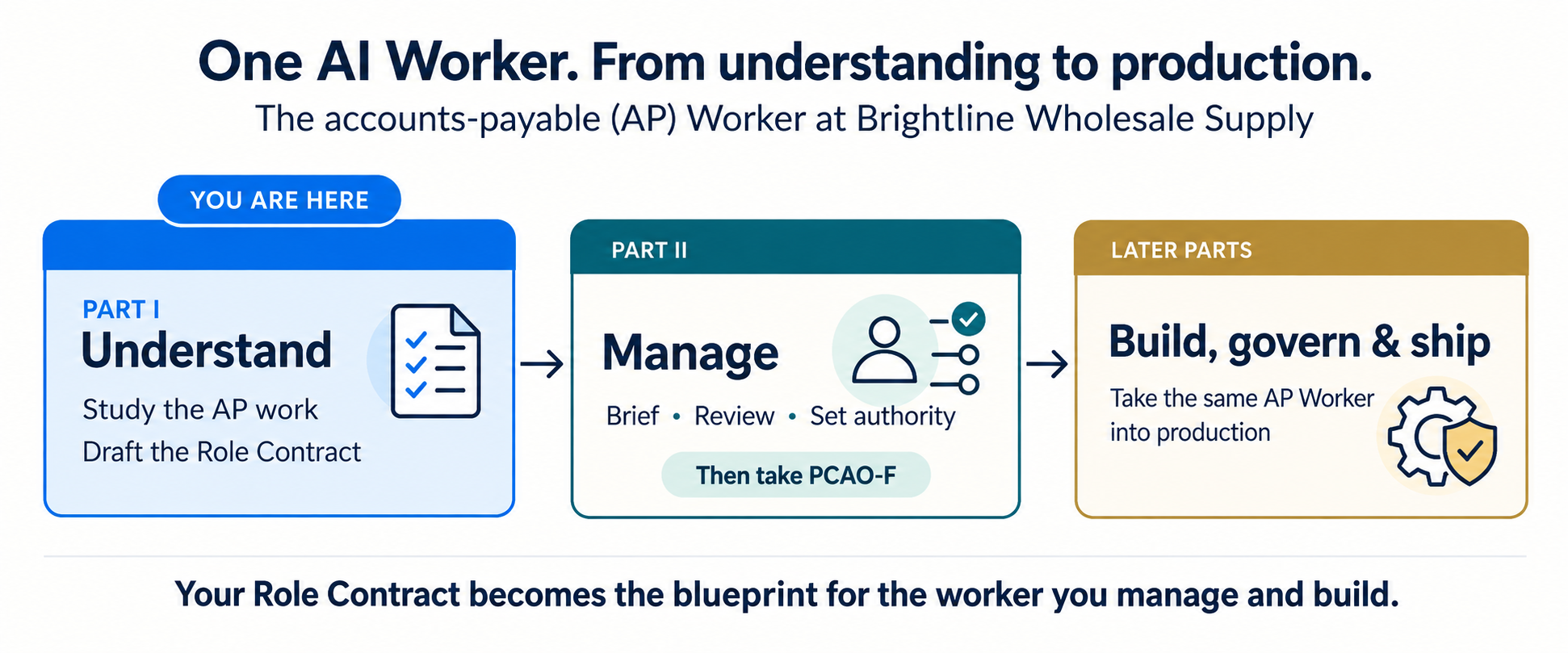
Figure I.1. The AP Worker's path through the book.
The four chapters
| Chapter | What it teaches | What you make |
|---|---|---|
| 1. From Chatbots to AI Workers | The ladder of interaction, where AI work runs and where its results are kept, and how to read a product announcement | A portable brief, run on both AI vendors or on one with a predicted port, and a work inventory for the AP role |
| 2. What Is an AI Worker? | The anatomy of an AI Worker, and how it differs from a model, an agent, an assistant and an automation | The first Role Contract draft |
| 3. The 10-80-10 Operating Rhythm | Set the intent, let the worker execute, verify the outcome. The three ways it goes wrong | Your Role Contract, refined with its review checks |
| 4. The Architecture in One Picture | KSoR (the Knowledge System of Record) knows, memory remembers, DSoR (the Data System of Record) acts, runtimes execute, channels connect. DSoR is also where a worker's authority is enforced. Which layers you rent, and which knowledge, policies and records you own | Your Role Contract, refined with its knowledge and authority named |
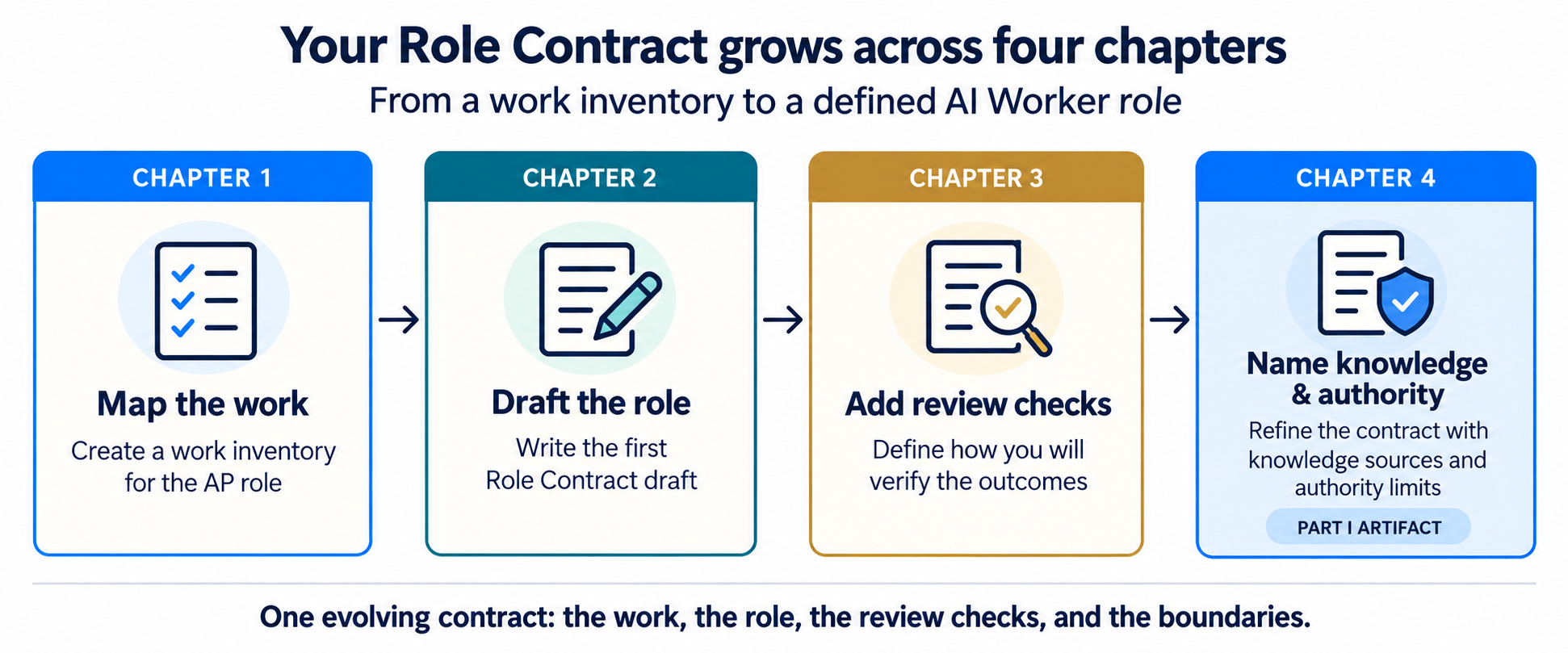
Figure I.2. The Role Contract across Chapters 1 to 4.
What you need
- To start: one AI vendor. An account with either of the two AI vendors this book covers, Anthropic or OpenAI, is enough to start and to finish each lab.
- For the full comparison: both AI vendors. Most labs run the work on one AI vendor and then port it to the other. With only one account, you write the port as a prediction. Each lab says what counts as finished on that path.
- Plans. Free plans4 are enough to start.5 Some newer features are available on paid plans first.1 Each lab says what it needs.
- The lab folders. Each lab comes as a zip file from the Labs companion. It holds the data, templates, step-by-step instructions, troubleshooting and an answer key.
- Time. Each chapter takes about 30 to 45 minutes to read, plus about 15 minutes with its check-yourself questions. Each lab lists its own time. Chapter 1's lab takes about 90 minutes of active work, spread over two days.
How Part I prepares you for the exams
Part I builds foundations. It does not finish any exam topic on its own.
- On the Anthropic side, it prepares you for parts of two CCAO-F domains, Domains 3 and 5.6 Part II completes both.
- On the OpenAI side, it covers the first two competencies in the book's OpenAI competency map. The first is choosing among ChatGPT chat, ChatGPT Work, dots and Space (Chapters 1 and 2). The second is choosing a model and reasoning effort (Chapter 2). OpenAI publishes no exam guide this book can follow, so the book builds this map from OpenAI's documentation.
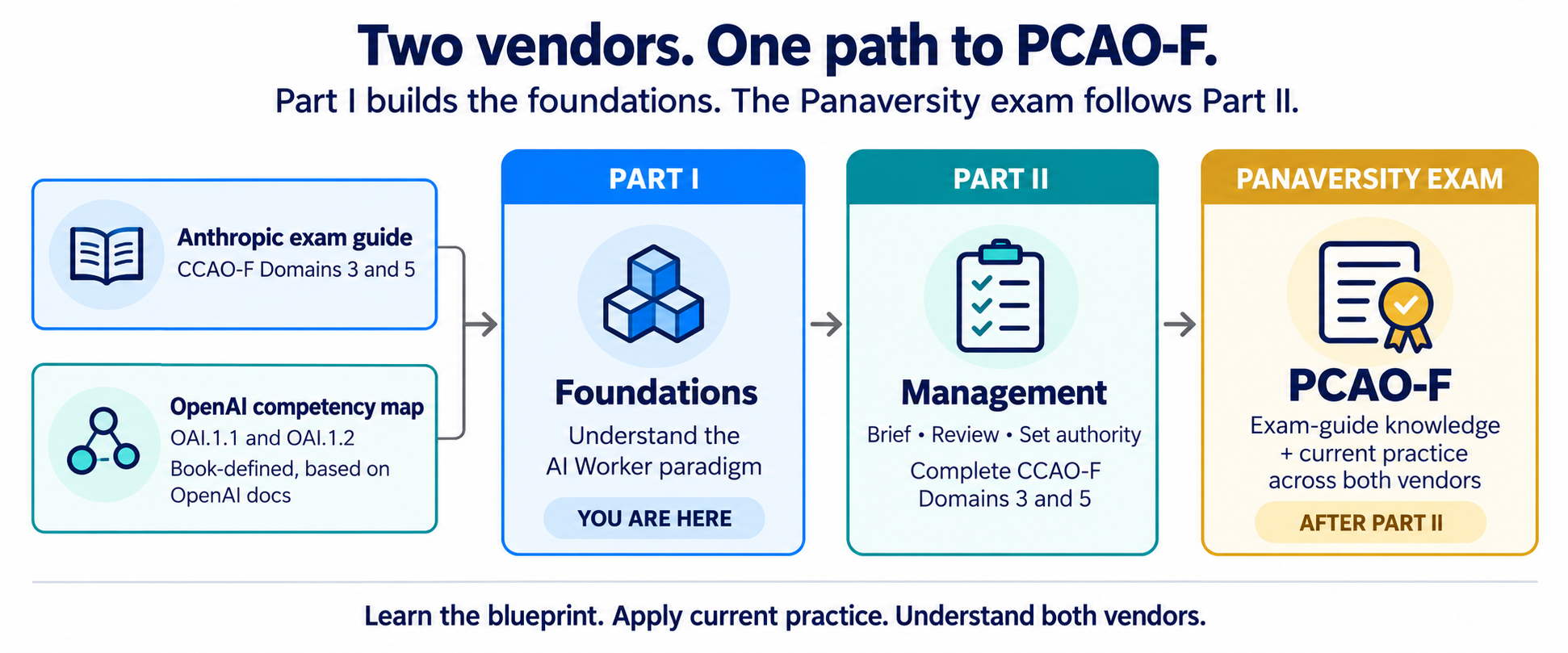
Figure I.3. How Part I feeds PCAO-F.
PCAO-F, the Panaversity exam you take after Part II, tests two things: the Anthropic exam guide, and current practice on both AI vendors.7 Each chapter ends with exam notes that show where the exam guide's wording differs from current practice. Quiz items are tagged blueprint when they follow the exam guide and current when they follow today's products. Learn both.
How to read this part
Read the chapters in order. Each one uses ideas from the one before. Do each lab when you reach it, because your Role Contract grows from the labs. If you get stuck, ask Zia Tutor AI. It is built on this book, and it can explain this part's concepts and quiz you on them.
Sources
- Claude Cowork and chat are one Claude, Claude Help Center, updated 16 September 2026.↑↑2
- ChatGPT is now a partner for your most ambitious work, OpenAI, 9 July 2026.↑
- Introducing dots, OpenAI, 29 September 2026.↑
- Plans and Pricing, Claude.↑
- Pricing, ChatGPT.↑
- Claude Certified Associate: Foundations Exam Guide, version 1.0, Anthropic, effective July 2026.↑
- Panaversity Certified Associate: Foundations (PCAO-F), The AI Agent Factory, first edition.↑
Certification and Portfolio Roadmaps
The PCxx exam path and the internship gate, the Anthropic certifications that correspond to each exam, and the portfolio each reader route produces.
Chapter 1. From Chatbots to AI Workers
What changed behind the AI text box between 2023 and 2026, the ladder of interaction, where AI work runs and where its results are kept, and how to read a product announcement.