1.1 The ladder of interaction
- Status
- stable
- Owner
- Panaversity
- Approved
- Panaversity ·
In everyday life. You look up pizza places near you (a query). You text a friend, "Which one is good?" (a message). You ask your roommate to order and pick it up (a task). You put one person in charge of Friday dinners for the house every week (a role).
Every era of computing has a unit of interaction. That unit is the thing you hand over and the thing you get back. When the unit changes, the skill you need changes with it. The ladder of interaction names four rungs:
Search engines are queried. Chatbots are prompted. Agents are delegated tasks. AI Workers are managed.
| Rung | You hand over | You get back | Who does the work |
|---|---|---|---|
| Search engine | A query | A list of links | You read, judge and act |
| Chatbot | A message | A reply | You copy, check and finish the job |
| Agent | A task | A finished output | The agent works, you review |
| AI Worker | A role | Recurring results, with evidence | The worker works, you manage |
An agent is the technical mechanism: a model in a loop with tools. It plans, acts, checks the result and acts again. An AI Worker is a business definition. It is a role-based AI system with identity, responsibilities, skills, knowledge access, tools, bounded authority, channels, evaluation criteria, and enough continuity to do recurring work.
At work. An accounts payable (AP) clerk searches a vendor's website and asks a chatbot what an invoice due date is. Next, the clerk delegates one invoice register to an agent. Finally, the clerk manages an AP Worker that builds the register every week. One register is a task. A register every week is a role.
The two are easy to confuse. A single delegated task shows agentic execution. It becomes the work of an AI Worker only when it is done inside a defined role, with responsibilities, authority and an accountable owner. An agent may be part of an AI Worker. Not every agent is one. Chapter 2 looks at the AI Worker one part at a time.
Beyond the four rungs, an AI Workforce is several AI Workers composed under human management. Part V teaches it.
Each rung up moves more of the work away from you. It also needs more control, because you hand over more authority and watch less of what happens. A search result needs your judgment, but the search engine acts on nothing. A role acts for you again and again, so it needs management. That is why the book's operating rule is: Humans define intent. AI Workers execute. Humans verify outcomes.
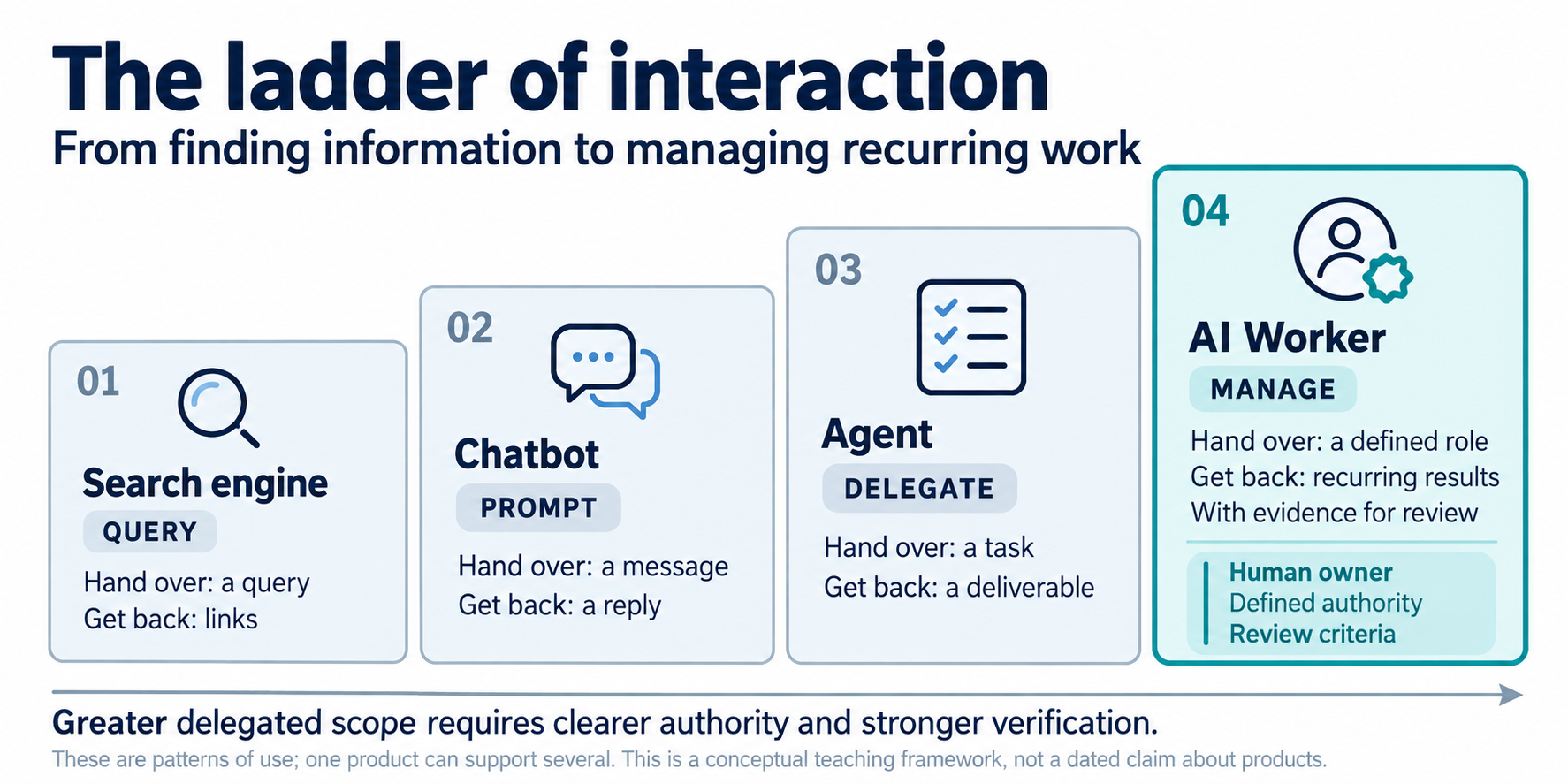
Figure 1.1. The ladder of interaction.
Check yourself
Question 1 / 8 · current
0 answered
On the ladder of interaction, what do you hand over to an AI Worker?
Chapter 1. From Chatbots to AI Workers
What changed behind the AI text box between 2023 and 2026, the ladder of interaction, where AI work runs and where its results are kept, and how to read a product announcement.
1.2 The same text box, a different destination
Why the same text box now leads either to an answer or to work, and what decides which one you get.