2.1 The anatomy of an AI Worker
- Status
- stable
- Owner
- Panaversity
- Approved
- Panaversity ·
In everyday life. A family hires a babysitter for every Friday night. Before leaving, the parents say who she is answering to and what she must do: dinner, homework, bed by 8. They say what she may not do: no guests, no driving. They also say whom to call if something goes wrong, and how they will know the evening went well.
Chapter 1 defined an AI Worker as a role-based AI system with identity, responsibilities, skills, knowledge access, tools, bounded authority, channels, evaluation criteria, and enough continuity to do recurring work. That definition is a list. To manage a worker, you need the full list, sorted into the questions a manager actually asks. This book uses a framework of sixteen elements in five groups. It is a management checklist, not the only possible definition.
| Group | Element | What it answers | AP Worker at Brightline |
|---|---|---|---|
| Who it is | Identity | Which account it acts as | Its own account, not a person's login |
| Role | Its job title | AP Worker | |
| Mission | Why the role exists, in one sentence | Pay vendors correctly and on time, and never pay twice | |
| Accountable human owner | Who answers for its results | The controller, by name | |
| What it owes | Responsibilities | The recurring work it does | Build the weekly invoice register, answer vendor status questions |
| KPIs (key performance indicators) | How the business measures the role | Duplicate payments found, late fees avoided | |
| What it works with | Knowledge | What is officially true | The approved AP policy |
| Memory | What it remembers from experience | Which vendors send scanned PDFs | |
| Skills | Procedures it knows how to follow | How to check an invoice total | |
| Tools | Systems it can call | Inbox, shared drive, spreadsheet | |
| What bounds it | Authority | What it may observe, recommend, draft, execute (do it itself) or escalate (hand it to a person) | May draft, never change bank details |
| Escalation | When it must stop and ask, and whom | Any bank-detail change goes to the controller | |
| Evaluations | How its behavior is tested, before and during use | The 15-invoice test set from Chapter 1 | |
| How it runs and is reached | Channels | Where people reach it | The team chat app, the AP inbox |
| Triggers | What starts its work | Monday morning, a new vendor email | |
| Runtime | What executes it | Whatever the company chooses, replaceable |
Four pairs are easy to confuse, and each confusion causes a different failure.
- Tools and authority. Tools are what the worker can call. Authority is what it may do. Brightline's assistant could edit the register, so it did. Nobody had said it must not.
- Knowledge and memory. Knowledge is the governed, official record. Memory is non-authoritative continuity: preferences, experience, where to look. Memory never overrides knowledge. Brightline's March policy copy was neither knowledge nor memory. It was a file that nobody managed.
- KPIs and evaluations. KPIs measure the business result of the role. Evaluations test the worker's behavior on cases with known answers. A worker can meet its KPIs for months and still fail a test case it has not seen before.
- Identity and owner. Identity is the account the worker acts as. The owner is the human who answers for it. Brightline had neither: the task ran as Dave, and Dave was not watching.
Compare the Brightline story with the table, and every failure matches a row. The assistant had no owner, no stated authority, no escalation rule, an out-of-date policy copy, a borrowed identity and no evaluations. The anatomy is a checklist for exactly these gaps.
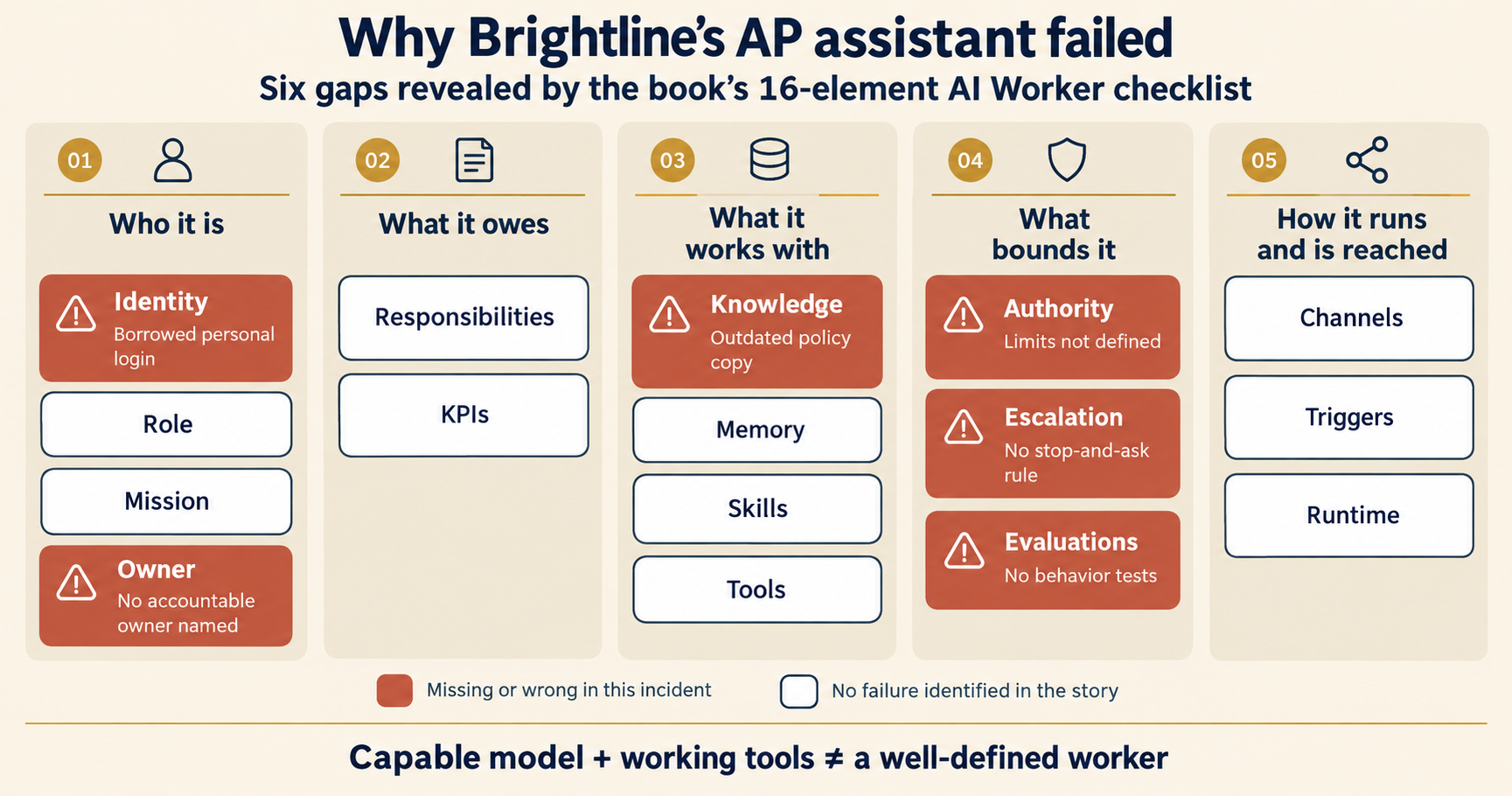
Figure 2.1. The Brightline failure, shown on the anatomy. Six elements were missing or wrong.
Check yourself
Question 1 / 9 · current
0 answered
Brightline's assistant could edit the invoice register, so it changed a vendor's bank details. Which element was missing from its definition?
Chapter 2. What Is an AI Worker?
The sixteen elements that define an AI Worker, how a worker differs from a model, an assistant, an automation and an agent, how to choose a surface and a model, and the first draft of a Role Contract.
2.2 Five things people call "AI"
What a model, an assistant, an automation, an agent and an AI Worker each are, how they nest, and two questions that tell them apart.