3.6 The three failures
- Status
- stable
- Owner
- Panaversity
- Approved
- Panaversity ·
In everyday life. A dinner party goes wrong three ways. Nobody told the cook about the guest's allergy (no brief). You stood over the cook all evening (micromanaging). Nobody tasted the sauce before serving it (no review).
The rhythm breaks in three ways. Brightline's October 1 showed all three.
| Failure | What it looks like | Why people do it | What it costs | The fix |
|---|---|---|---|---|
| Skipping the first 10 | A one-line request. No period, no limits, no stop rule, no evidence asked for | It feels faster. It is the habit of the chatbot era | The wrong deliverable, or the right one reached by the wrong means. Time saved at the start is lost to rework | Write the four parts and the five review questions. Save the brief as a template for next time |
| Micromanaging the 80 | Approving every harmless step, feeding work in one item at a time, retyping drafts, steering each step | Low trust, often after one bad result | You become the operator again, and pay for the worker too | Move the worry into the first 10: a stop rule, narrower authority, or a smaller first task |
| Skipping the last 10 | Accepting "Completed," forwarding work unread, approving because it looks professional | The output looks finished, and there is a lot of it | Often the costliest, because unchecked errors can reach vendors, customers or the books under your name | Read the flags first, then the evidence. A named person approves. Nothing leaves before that |
Maria's caution was not wrong. Money was at risk, and she had a bad experience before. Her mistake was where she put the caution. A stop rule in the first 10 percent gives the same protection, and she does not have to do the work twice. One example is "ask me before adding any invoice over $5,000."
When a delegation goes wrong, find where to look first before you fix anything. Failures can combine, so treat the answer as a starting point, not the only cause. Ask three questions in order.
- Did the brief, contract or policy say it? Check the brief, the Role Contract and any policy the worker was given. If none of them told it the period, the limit or when to stop, start with the first 10 percent.
- Did the worker act against them? If it acted beyond what they allowed or did not stop when a rule applied, start with the middle. Look at the worker's record of the run, and at its inputs and permissions. Chapter 11 teaches that diagnosis.
- Was the problem visible in the evidence? If the warning was there and nobody read it, start with the final 10: fix the review, not the worker. If the problem was not visible, find out why. The review contract may have asked for too little evidence, a first-10 fix. The worker may have left out evidence it was asked for, a middle-80 fix. Or a source may have been wrong, which is fixed in the inputs.
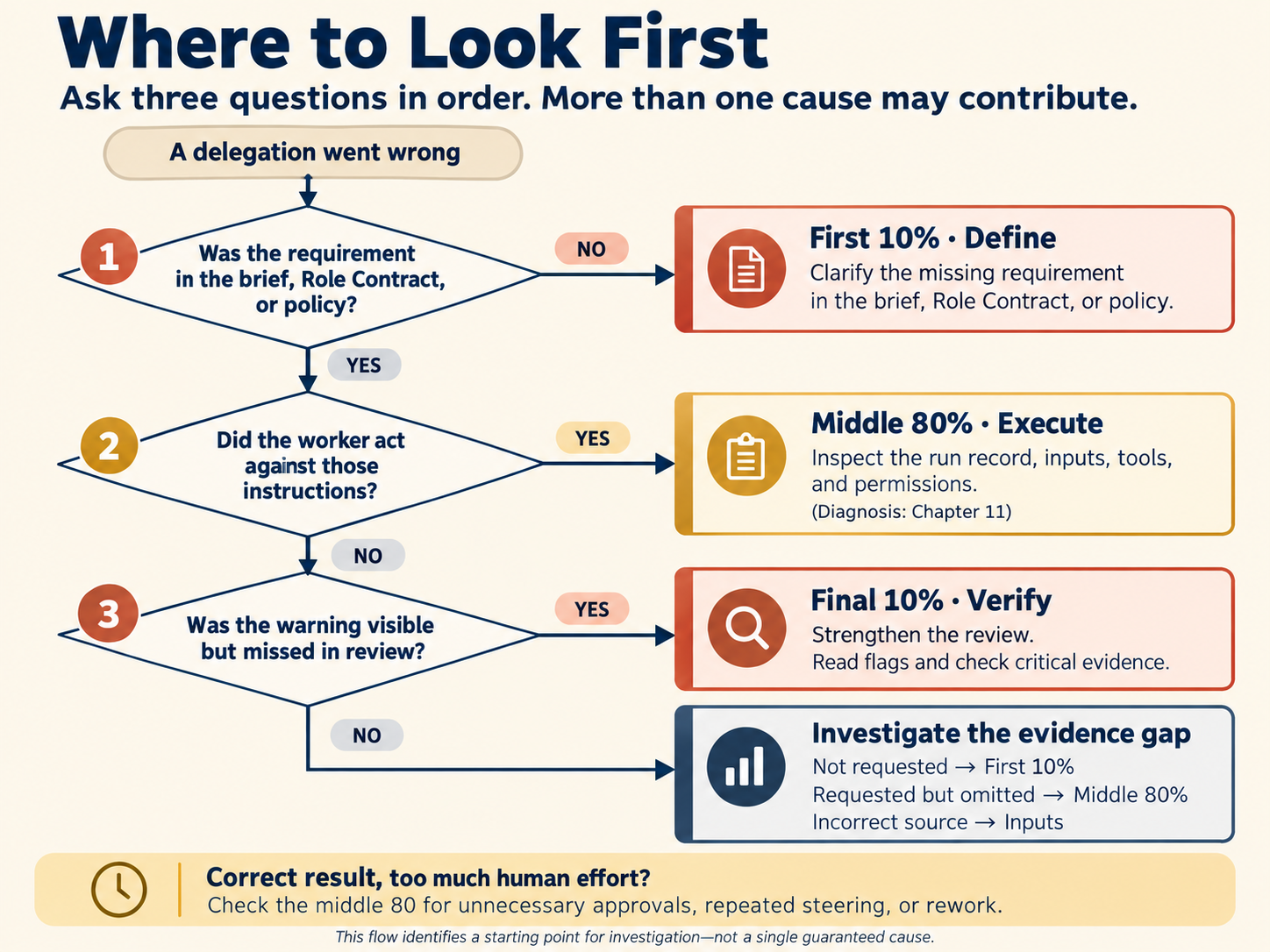
Figure 3.3. Where to look first. Three questions, asked in order, point to the first place to investigate. Failures can combine.
Applied to Brightline: Dave's 9 a.m. table was a first-10 failure, because nothing told the worker that this task must change nothing. Maria's 11 a.m. register was a middle-80 failure, caused by the person rather than the worker. The three questions would not find it, because her register was correct. This failure shows up as time, not as errors. If a delegated task takes you as long as doing it by hand, look at what you did during the middle. Dave's 4 p.m. close was a final-10 failure. The worker did its job, and the reviewer did not.
Check yourself
Question 1 / 8 · current
0 answered
A one-line request returns a tidy table built by changing data. Which part broke?
3.5 Three scales: a task, a worker, a company
The same rhythm at three scales: one task, a worker's working life, and how a company governs its AI Workers.
3.7 How the two leaders support the rhythm
How the two AI vendors support the rhythm in work that runs on a schedule, the difference that changes a design, and what stays true on both.