4.1 Five layers, five verbs
- Status
- stable
- Owner
- Panaversity
- Approved
- Panaversity ·
In everyday life. Think of a restaurant. The front door and phone line are its channels, and the cook is its runtime. The cook's own habits are its memory, and the recipe book is its KSoR. The manager's key to the cash register and the stockroom is its DSoR.
Every AI Worker in this book is drawn the same way: five layers, one job each.
| Layer | Its verb | What it holds or does | Brightline example |
|---|---|---|---|
| Channels | connect | Where people and systems reach the worker: a chat app, team messaging, email, a web portal, an API | The AP inbox, the team chat |
| Runtime | executes | The replaceable harness that reasons and acts | The AI vendor's app running a task |
| Memory | remembers | Continuity: preferences, experience, where to look | "Maria wants the register sorted by due date" |
| KSoR | knows | The governed, authoritative knowledge: policies, procedures, thresholds, definitions | AP policy, approval limits |
| DSoR | acts | The governed door to real systems: it checks, acts, and keeps the evidence | Register updates, payment status |
Two things sit outside the five layers. Above them is the human principal, who owns the first 10 and the final 10 percent of every task (Chapter 3). Below DSoR are the company's own systems: the accounting system, the bank and the vendor records. They stay the authority on their data.1 DSoR does not replace them. It governs the worker's access to them.
Where is the worker itself? It is not one box. The worker is the Role Contract from Chapter 2, and the contract ties the layers together. It names the knowledge sources, the memory rules, the operations the worker may request, the runtime it needs and the channels it serves.
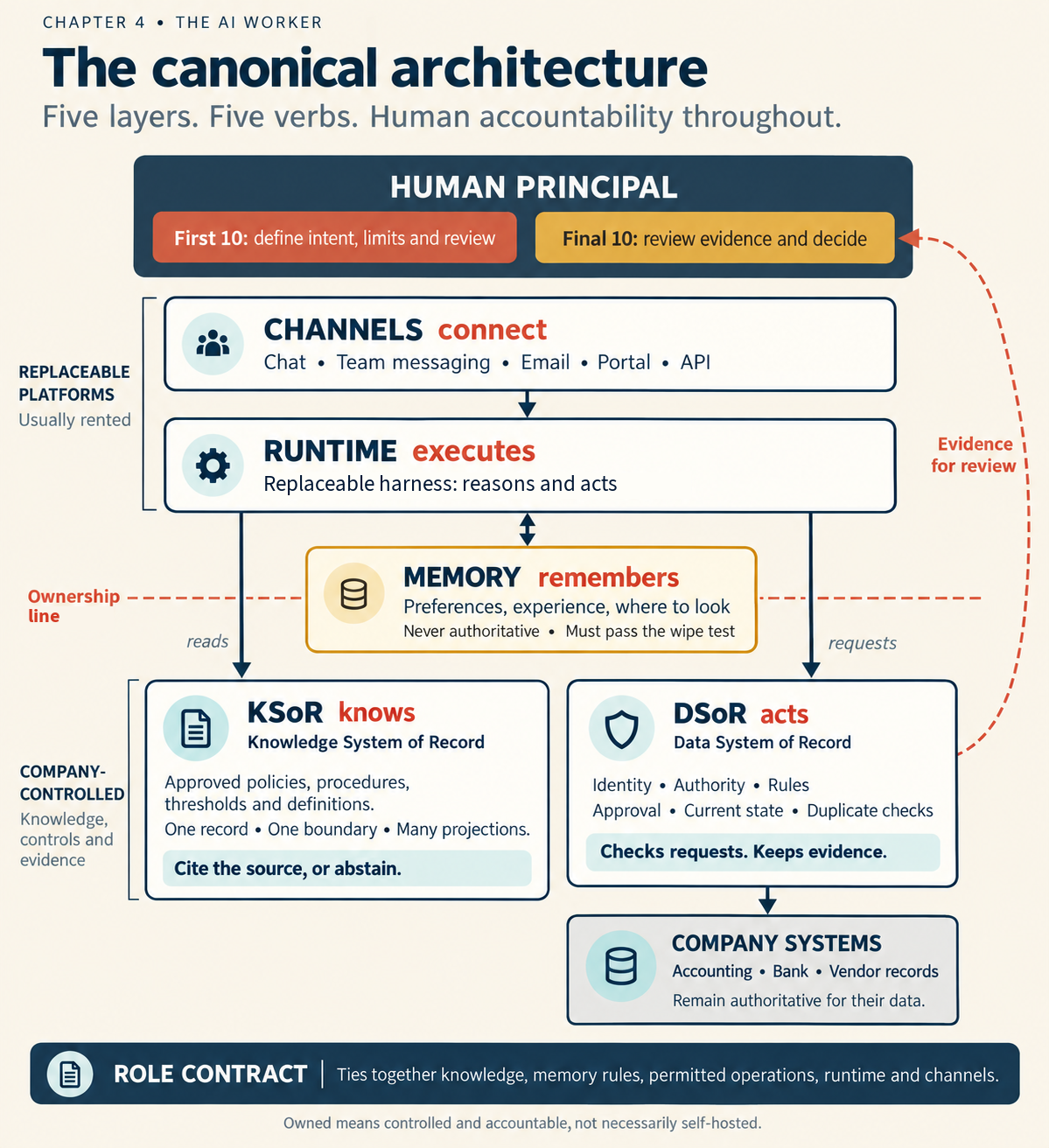
Figure 4.1. The canonical (standard) architecture. Channels connect, runtimes execute, memory remembers, KSoR knows and DSoR acts. Rented layers sit above the line and owned layers below it.
This is the only architecture diagram in the book. Later chapters zoom into one layer at a time. When a chapter introduces a product or a technique, ask one question first: which layer is this?
Check yourself
Question 1 / 8 · current
0 answered
Which layer of the canonical architecture executes the work?
Sources
Chapter 4. The Architecture in One Picture
The one picture this book uses for every AI Worker: five layers with one job each, which layers a company rents and which it must own, who wins when two layers disagree, and the rule that splits knowing from doing.
4.2 KSoR knows
The layer that holds what a company officially knows, kept as one approved record that people and workers both read.