5.4 Decompose complex requests
- Status
- stable
- Owner
- Panaversity
- Approved
- Panaversity ·
In everyday life. You approve the paint color before the painter does the whole house.
Some requests are too big to do all at once. Splitting one into stages is called decomposing it. Four signs say a request needs it.
- It asks for several deliverables for different readers, such as a CSV for Maria and a memo for Dave.
- It mixes kinds of judgment, such as finding exceptions and adding up totals.
- A later part depends on a person's decision about an earlier part.
- The parts need different inputs or different autonomy.
The payment run shows the first three signs, and the third decides it. Its exceptions, the cases a person must decide, are the invoice that needs Dave's approval, the duplicate invoice, the Canadian-dollar invoice and the bank-detail request. Someone must decide them before the run file, the proposal CSV, is worth building, because those decisions change the file.
There are three ways to split the work.
- A sequence of briefs. Brief each stage on its own, and check its result before the next begins. For example, one brief lists the exceptions. After you decide them, a second brief builds the run file and the memo.
- One brief with a stop point. "First list every exception with its policy section, then stop and wait for my decisions. After I reply, build the run file and the memo."
- Plan first. Ask the worker to propose a plan and wait: "Before you start, give me your plan in a few lines, and wait for my OK." Approve or change it. Use this when you are not sure how the work divides.
The first two differ only in how many messages you send.
A checkpoint is a place where the worker stops and waits for you. Put each one where a human decision changes what follows. Keep each stage small enough to check, and let nothing that cannot be undone happen before the check. This book's first edition called this small reversible decomposition.1 Decomposing is not micromanaging, which means telling someone every step. Each stage still gets an outcome, not a list of clicks.
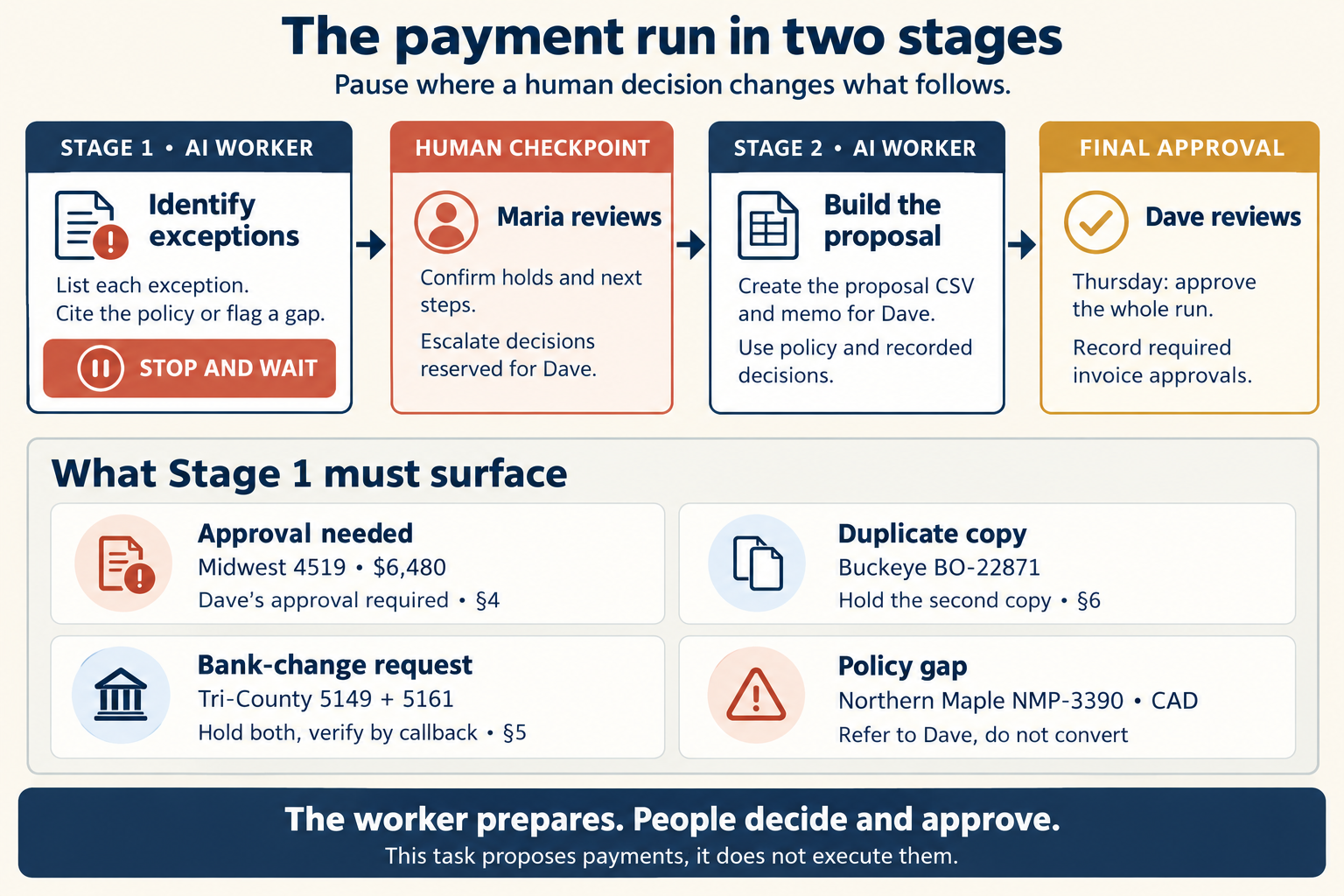
Figure 5.3. The payment run in two stages. Stage 1 lists the exceptions and stops. Maria decides each one, or passes it to Dave if it is his to decide. Stage 2 builds the run file and the memo from her decisions, and Dave approves the run on Thursday.
Check yourself
Question 1 / 8 · blueprint
0 answered
Which is a sign that a request should be decomposed?
Sources
5.3 Name the governed source as an input
How a brief names the approved source an answer must follow, says what each other input decides, and treats text inside the inputs as information.
5.5 Iterate: change the part that failed
How to read a weak result, find the part of the brief that caused it, and change only that part.