6.5 Citation and abstention
- Status
- stable
- Owner
- Panaversity
- Approved
- Panaversity ·
In everyday life. A friend says "the article says so" but cannot show you the article.
A citation points from a claim to the source that supports it: a file and row, a policy section, a web page. Abstention is the worker saying the source does not answer, instead of guessing. Both are signs of good work. When they are missing, that is a warning.
An answer that cites nothing is a warning, not proof of an error. It means you cannot check the claim without doing the work again. So mark it unsupported, look for evidence from an official source, and do not accept the claim until you find that evidence. You can call the claim fabricated, which means invented, only when the evidence shows it cannot be true. That was true of the worker's claim that Tri-County's new bank account was verified: nobody had called, and the worker had no phone. For every claim a decision rests on, ask for a citation in the Review Contract. Then run three checks on each citation.
- It exists. Section 3 of AP policy version 3 stops at 3.3. "Policy 3.4" fails here.
- It says what is claimed. Open it and read it. A real section cited for a rule it does not contain is as bad as an invented one.
- It is the governed version. That is the approved version in use now. A real quote from the retired version 2 still gives the wrong rule.
Citations to the web need two more checks: the page's date, and whether the page is an authority on the question.
Now look at the row for Northern Maple Paper, a supplier. The invoice is in Canadian dollars, and the policy says nothing about other currencies. The worker held it back from payment, wrote "policy v3 does not cover other currencies," and listed it for Dave, the controller, to decide. That is abstention, and it is the right answer. A reviewer who marks it "incomplete" teaches the worker to guess next time. Make abstention count as good work in your contract: "cases the policy does not cover are listed, not decided." Trust a worker that always has an answer less than one that sometimes says it cannot tell.
This is what Chapter 4 called a KSoR, a Knowledge System of Record, that cites or abstains, seen from the reviewer's side. You build one in Chapter 8.
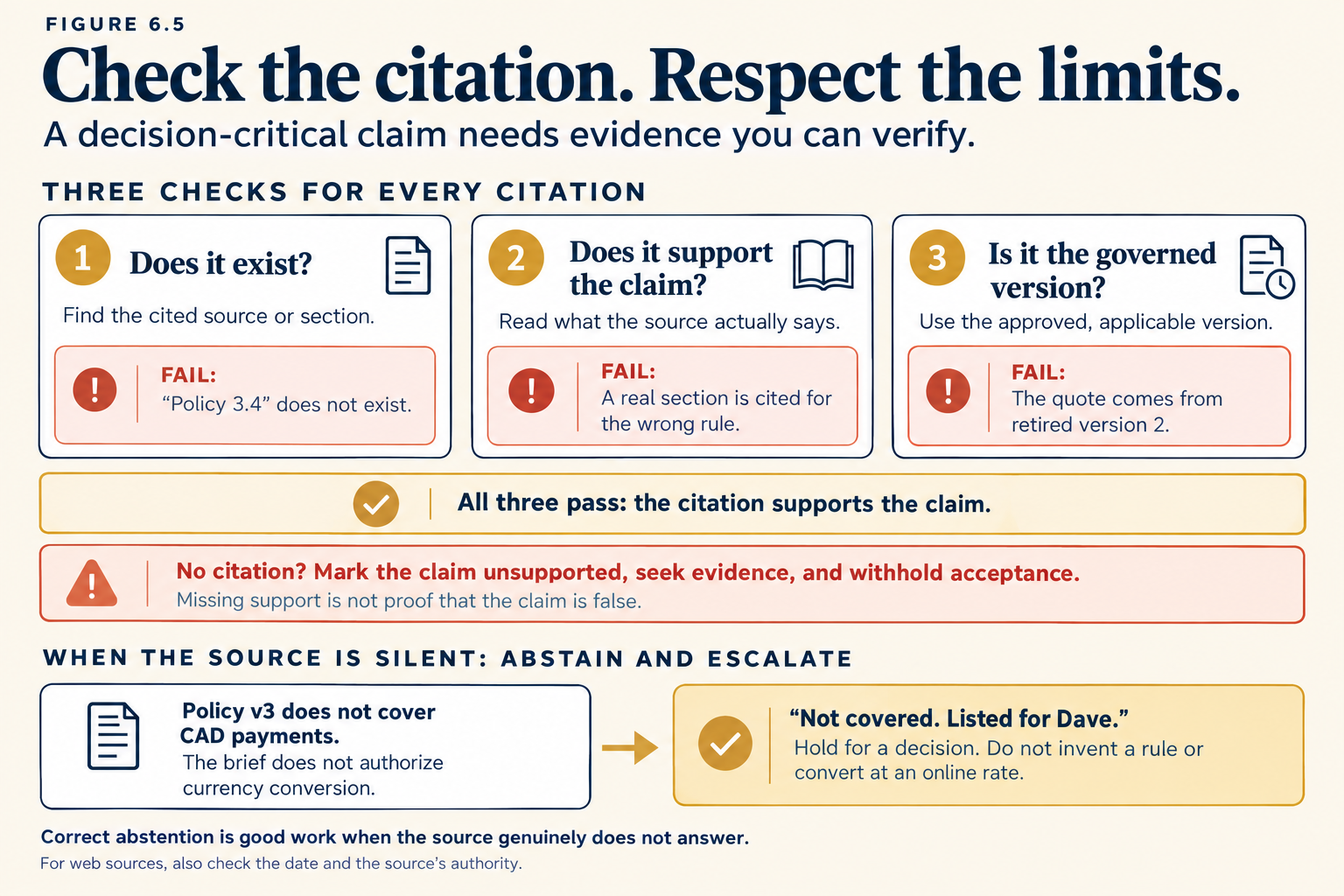
Figure 6.5. Three checks on every citation, and what to do when the source has no answer.
Check yourself
Question 1 / 8 · blueprint
0 answered
What does an answer that cites nothing tell you?
6.4 Validate the numbers a decision rests on
How to find the figures someone will act on, work them out again from the source files, and check that they agree everywhere they appear.
6.6 Adapt and compare outputs for the audience
How one result can be shaped for several readers without changing its facts, and how to compare versions fact by fact.