6.2 A good output and a plausible one
- Status
- stable
- Owner
- Panaversity
- Approved
- Panaversity ·
In everyday life. A restaurant bill is neatly printed and added up, but it still charges for a dish you never ordered.
A plausible output has the shape of a right answer. It reads smoothly, and it is organized and confident, with headings, totals and citations, the sources it names. A good output matches the outcome you asked for in the brief and the sources it worked from. AI makes plausible output easily, whether or not it is good. Brightline's AP Worker handles the bills the company owes. The memo it sent with Friday's payment run was plausible in every line.
People trust text that is easy to read, even though being easy to read has nothing to do with being true. Researchers call this processing fluency.1 So asking "does this feel right?" as you read is the weakest check you have. Run two stronger checks instead.
- Completeness. Match each item by its ID, not only by the count. Every invoice in the source must appear exactly once in the output: none missing, none repeated, none extra. Friday's run had 15 open invoices. A file with one row missing and another row repeated would still have 15 rows. Check that every part the brief asked for is there: the CSV (a spreadsheet file with one row per invoice), the memo and the note. Check that every decision Dave, the controller, must make is in the memo. A reader cannot see a missing row. A match shows it at once.
- Accuracy. Trace claims back to the source. Trace every claim a decision rests on, and a sample of the rest. A row is accurate when its amount, date, action and reason all match the files and the policy.
"All 15 open invoices were reviewed" is a claim like any other. The CSV had 14 rows. The worker's own task record, its log of the run, said "14 rows." Completeness checks find what accuracy checks cannot, because there is no row to trace.
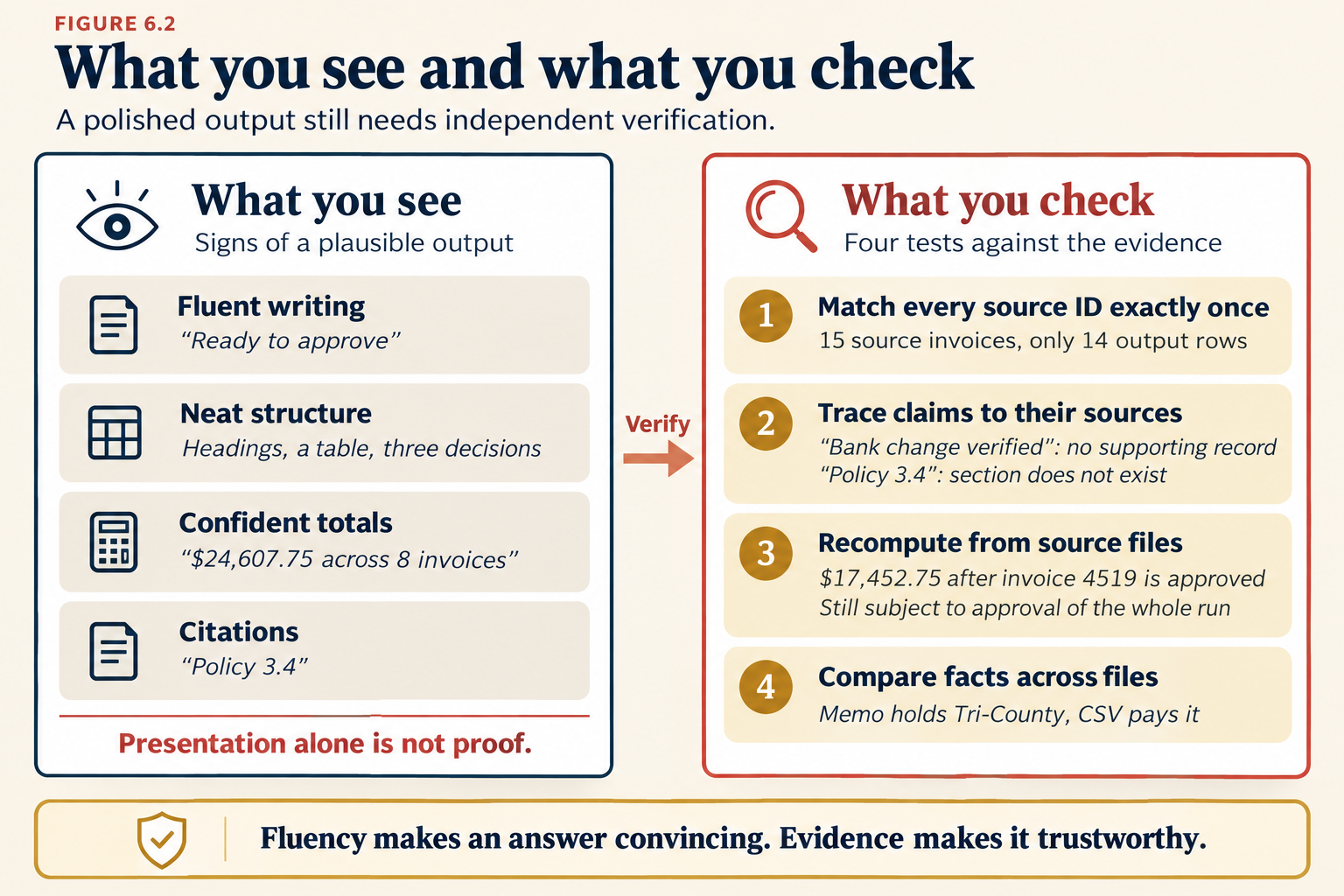
Figure 6.2. What you see and what you check. A plausible output shows fluency, structure, totals and citations. None of those is evidence. The evidence comes from four checks: match every source ID once, trace each claim, recompute each number a decision rests on, and compare the files with each other.
Check yourself
Question 1 / 8 · blueprint
0 answered
What makes an output plausible but not good?
Sources
6.1 Agree the checks before you delegate
What to check, what evidence to ask for, what counts as success and when the worker must stop, written down before the work starts, and how deep a review should go.
6.3 Hallucination, inconsistency and bias
Three different ways a result goes wrong, and the test that finds each one.